
Ethical & Legal Issues
Dilemmas in the Digital Classroom
(Week 11)
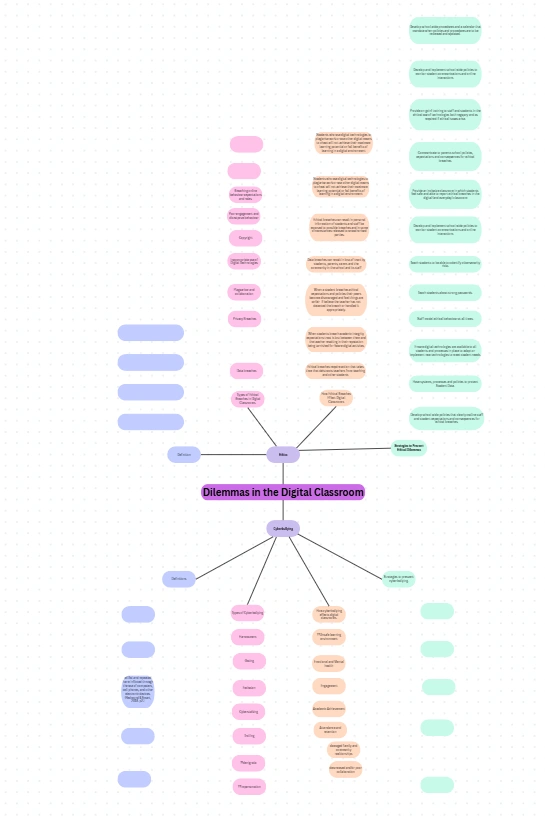
Concept Map of Ethical Dilemmas in Digital Classrooms
Rationale to Support Concept map of Dilemmas in the Digital Classroom
My greatest surprise when preparing this map was the wide scope of issues that need to be considered in order to manage and eliminate ethical breaches and cyberbullying in classrooms. Plus, how difficult this task may truly be. I agree with Redmond (2019) that a “awareness program designed for educators” must be developed because teachers are unable to report cyberbullying if they are unable to identify it (Redmond pX). Any such programme however will also need regular review and updating because “education needs to catch up” and keep up “with the changing norms of Internet usage” (Buchannan). This task also highlighted for me the scope of, and damage caused by ethical breaches involving plagiarism. To date the only attempts I have seen of student plagiarism which involved students using AI to generate short story narratives and cutting and pasting text from AI, websites and Google searches straight into assessment tasks. Luckily, they were not very sophisticated attempts and were caught at the drafting stage. The result was students were made to start the task again, and in some cases had to complete pencil and paper assessment with no further access to technology.
Bibliography
Buchanan, Rachel. (2019). Digital Ethical Dilemmas in Teaching. 10.1007/978-981-13-1179-6_150-1.
Redmond, P., Lock, J. V., & Smart, V. (2018). Pre-service teachers’ perspectives of cyberbullying. Computers & Education., 119, 1–13. https://doi.org/10.1016/j.compedu.2017.12.004