
Policy Curriculum and Educational Technology
The Four Elements of Digital Literacy
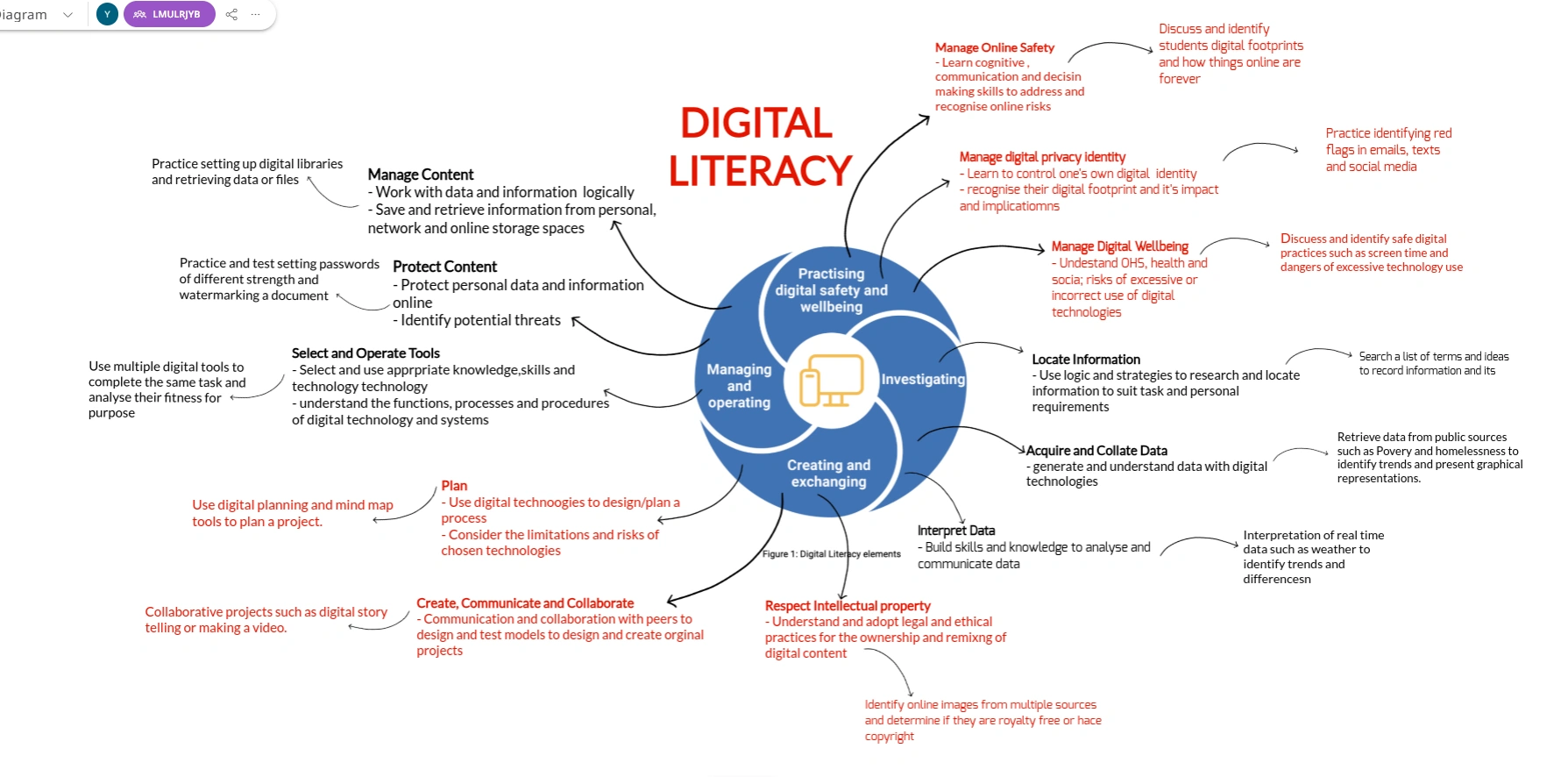
The link below will take you to a VENN Diagram which illustrates The 4 Elements of Digital Literacy.
https://whiteboard.explaineverything.com/#LMULRJYB
VENN Diagram Rationale
For the adoption of digital technologies to be successful teachers must ensure that computers in the classroom do not become what Littlejohn refers to as $1000 pencils (Littlejohn, 2016, p. 62.) This is because for the use of digital technologies to be purposeful and effective they must be used to complete tasks, research and assessment that cannot be done by traditional means. Hence, the activities I have proposed will ensure students learn to use technologies critically and competently while also developing the digital literacy skills and knowledge to enhance their learning and, in the future, “productively contribute to our society and economy” (Thomson, 2015, p. 916.). The activities will also ensure that students learn to do this safely while “applying appropriate social and ethical practices” (Newhouse, 2013, p. 4).
Ideas for the included activities are from multiple sources including ACARA and State Government education sites. Some activities are short and ideal for starter activities such as when students retrieve data or files from digital libraries established in previous lesson. Other activities can be combined into a complete lesson or to form a unit of work. For example, the content of the activities proposed under Investigation can be used as the basis for research projects. Combining of the proposed activities in the Practicing digital safety and wellbeing element also provide the base for an introduction lesson at the beginning of digital assessment tasks.
Bibliography
Littlejohn, C., & Hunter, J. (2016). Messy or not: the role of education institutions in leading successful applications of digital technology in teaching and learning. Australian Educational Leader, vol 38, no. 3:62, pp 62-65.
Newhouse, C. P. (2013). ICT in the Australian curriculum, In Proceedings of the 21st International Conference on Computers in Education, pp. 914-919, Bali, Indonesia, Uhamka Press.
Thomson, S. (2015). Policy insights: Australian students in a digital world #3, Australian Council for Educational Research.